Looking for a Partner to Build an AI Lease Abstraction Tool?
Leverage our expertise in real estate, legal, and financial industries to automate the lease management process.


Lease abstraction typically consumes 4-8 hours of a broker’s time due to management of complex cases and legal terminology. Although you can use ChatGPT to make processes faster, it is significantly limited by security concerns and memory limitations. Because of this, using dedicated AI lease abstraction tools has become essential for professional use.
At Ascendix Technologies, we’ve developed our own AI lease abstraction solution and learned valuable lessons about building enterprise-grade AI lease abstraction tools for real estate.
In this guide, we’ll cover:
AI lease abstraction is the process of extracting key information like parties’ responsibilities, lease terms, and financial obligations with the help of AI lease abstraction software from a commercial lease agreement and summarizing it into a concise document.
In fact, automated lease abstraction can save up to 25% of a broker’s time, according to CBRE.
A lease abstract is a concise structured summary of a commercial lease agreement that contains key details of the commercial lease, such as the legal terms, financial information, and the rights and obligations of the parties involved. Abstraction can be conducted for any other document types as well.
Leverage our expertise in real estate, legal, and financial industries to automate the lease management process.
The result of the automated lease abstraction should be presented in a concise but well-structured manner. Often AI lease abstract is in the form of a list or a table that includes the essential details such as:
Tenant Information – tenant’s full name and current address, their rent history, financial records, and the outcomes of background checks (if any were conducted);
Second Party – this section identifies the second party involved in the commercial lease agreement, typically the landlord or property owner. Their legal identity, contact information, and any pertinent details relevant to the lease should be clearly outlined;
Base and Total Prices – the basic rent as well as any additional costs associated with the property are a must in an AI lease abstract;
Parties’ Rights and Responsibilities – tenant termination rights, permissions related to property remodeling, and the tenant’s right of first refusal. As for the landlord’s rights and responsibilities – rent collection, property inspection, maintenance and repairs, eviction rights, and lease renewal;
Taxes – the lease abstract should specify which taxes are the responsibility of the tenant and which are the responsibility of the landlord;
Reimbursements – common area maintenance (CAM) fees or other costs that the tenant is obligated to reimburse the landlord for;
Property Details – property description, including its physical attributes, location, zoning information, etc.;
Title (Insurance) – the lease abstract AI should include details about the title of the property and whether title insurance is provided. Find out more about how title software works.
Security Deposit – the amount of the deposit, the conditions under which it may be withheld, and the process for its return to the tenant;
Important Dates – commonly, these are the lease start and expiration dates, provided by lease AI software;
Use Clauses – the lease abstract should outline the permissible uses of the leased property as specified in the commercial lease agreement, namely, types of businesses or activities allowed on the premises;
Termination Clauses – details about notice periods, termination penalties, and any specific circumstances under which the lease can be terminated by either party;
Other Critical Provisions – this section should encompass any additional important provisions specific to the lease agreement like insurance requirements or maintenance responsibilities.
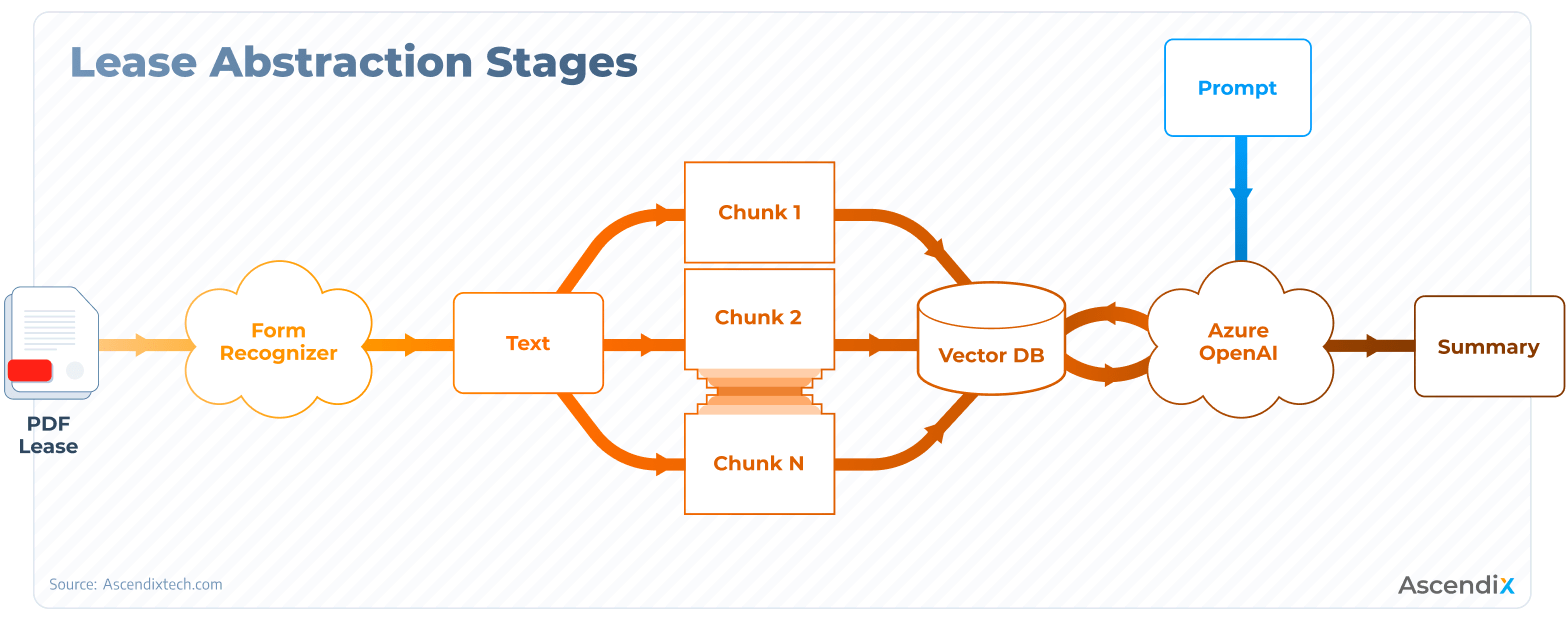
AI Lease Abstraction Stages
AI lease abstraction software workflows and stages may vary depending on the tool, model, database, and industry specifics, but overall, the abstraction process looks as follows:
1. Users register, authorize, and upload the document from a local storage or cloud-based repository onto the lease abstraction AI platform;
2. Once the lease is uploaded, the AI lease abstraction tool will employ Optical Character Recognition (OCR) systems to turn the document into machine-readable text.
OCR is a technology used to convert different types of documents, such as scanned paper documents, PDFs, or images captured by a digital camera, into editable and searchable data that can be further processed by NLP technologies, which we’ll talk about later;
3. OCR systems transform handwritten parts into computer-readable text, using technologies like Azure Form Recognizer. However, users need to manually review and edit the recognized handwritten parts for accuracy before the system can proceed to the next stage;
4. Because GPT can’t process texts that contain more than 8 thousand words, the text has to be further split into semantic parts or ‘chunks’ that will be processed separately. Such ‘splitters’ already exist and can be manipulated with libraries like LangChain;
5. The chunks are further stored in vector databases. A vector database ensures not just efficient storage and data retrieval but also provides quick search functionality, enabling you to swiftly navigate through various sections of contracts. Also, using databases eliminates the risk of fake or incorrect data present in the lease abstraction results. For this purpose, vector databases like Pinecone and Zillis can be used;
6. Further, users set up pre-defined prompts that ask the AI lease abstraction system to summarize the document and the system runs the prompts. This is where NLP technologies come to help. NLP, or Natural Language Processing algorithm, enables your lease summary AI tool to recognize and extract entities, such as tenant names, property details, rental amounts, and key clauses, from the text. In other words, it helps the tool make sense of the language used in legal documents, meaning the abstraction real estate happens smoothly and efficiently. The newest NLP model at the moment is GPT-5, only available to corporate clients and paid users at the moment, but with a limited number of prompts for free use.
Alternatively, you can implement a chatbot-like interface where users can interact with the AI lease abstraction tool in real time (like ChatGPT, for example). Ultimately, if Azure Open AI technology is used during this stage, it will convert the prompt into an embedded vector and conduct a similarity search to retrieve the semantic parts with the relevant data. Further, the parts are transformed into a summary;
7. The last stage is a two-step validation process when the system applies a similarity algorithm to compare the details of the commercial lease abstract with the original document and later asks users to check the lease abstract manually in order to ensure it makes sense to the reader.
If you use a self-improving AI model, every time you make changes to the final lease abstract, the system will remember your choices and improve the next summaries accordingly.
Both options have their benefits and drawbacks, but in most cases, it is best to use a dedicated AI lease abstraction tool rather than ChatGPT for professional work, since it provides higher security, more reliable insights, and better contextual awareness in the real estate industry.
Although you can, we strongly recommend not doing it. The key issues with using ChatGPT for AI lease abstraction are significant data privacy concerns and no real estate-specific expertise. OpenAI collects, stores, and processes all the information that you provide, and even though the data is protected and encrypted, there’s no guarantee that your sensitive details shared with ChatGPT cannot be stolen, leaked, or used as the training data for newer models or to improve the chat’s performance.
| ChatGPT vs Dedicated AI Lease Abstraction Tool | ||
|---|---|---|
| Aspect | ChatGPT | Dedicated Tool |
| Data security |
|
|
| Confidentiality |
|
|
| Accuracy |
|
|
| Legal awareness |
|
|
| Context understanding |
|
|
| Technical limitations |
|
|
| Integration capabilities |
|
|
| Transparency and reliability |
|
|
| Cost and ROI |
|
|
There are significant data security and confidentiality risks with ChatGPT, since OpenAI can use all data fed to the system for model training and improvement. When you input any lease documents containing tenant names, financial terms, addresses, or proprietary business information, you automatically lose control over where this data is stored and managed, which creates serious privacy violations.
ChatGPT is a general-purpose language model with very little legal awareness, unlike dedicated lease abstraction of AI tools built for real estate. ChatGPT cannot interpret clauses properly and has only a general idea of law and legislation, which, moreover, typically comes from open sources like blog articles and not official governmental sites. Therefore, trusting ChatGPT’s legal advice will almost certainly lead to inaccurate results and the need to double-check all the facts.
The technical limitations when handling bulk lease data must also be mentioned, as ChatGPT wasn’t designed for large-scale document processing. It can only manage basic document formats, has limited token capacity for processing, and can struggle a lot with complex PDF files or messy handwriting.
ChatGPT lacks integration capabilities with existing business systems, requiring manual copy-paste to transfer data to property management systems, CRMs, or document management tools.
Unlike specialized lease abstraction AI tools that offer full portfolio context awareness, ChatGPT is a generic tool without any context awareness. It cannot cross-reference documents, track lease amendments, or maintain knowledge of previous lease history and conditions, making it unsuitable for comprehensive lease portfolio management.
You need someone who has been in real estate for years if not decades – someone who’s learned the ropes of real estate software development and knows how to ensure that your AI lease abstract software includes the desired functionality aligned with your business needs, offers top security to users, and streamlines the lease management process.
Why not focus on generic software development providers? Well, from what we’ve heard from our clients who have cooperated with generic software development companies, onboarding and discovery stages might take forever, and there might be zero post-development support if you somehow manage to get to the development stage at all.
We’ve been in the game for 2+ decades and helped companies like JLL and Hanna Commercial automate their real estate operations with a proptech solution development. And unlike generic software development providers, we offer dedicated post-development support to ensure your software is scalable and efficient in the long run.
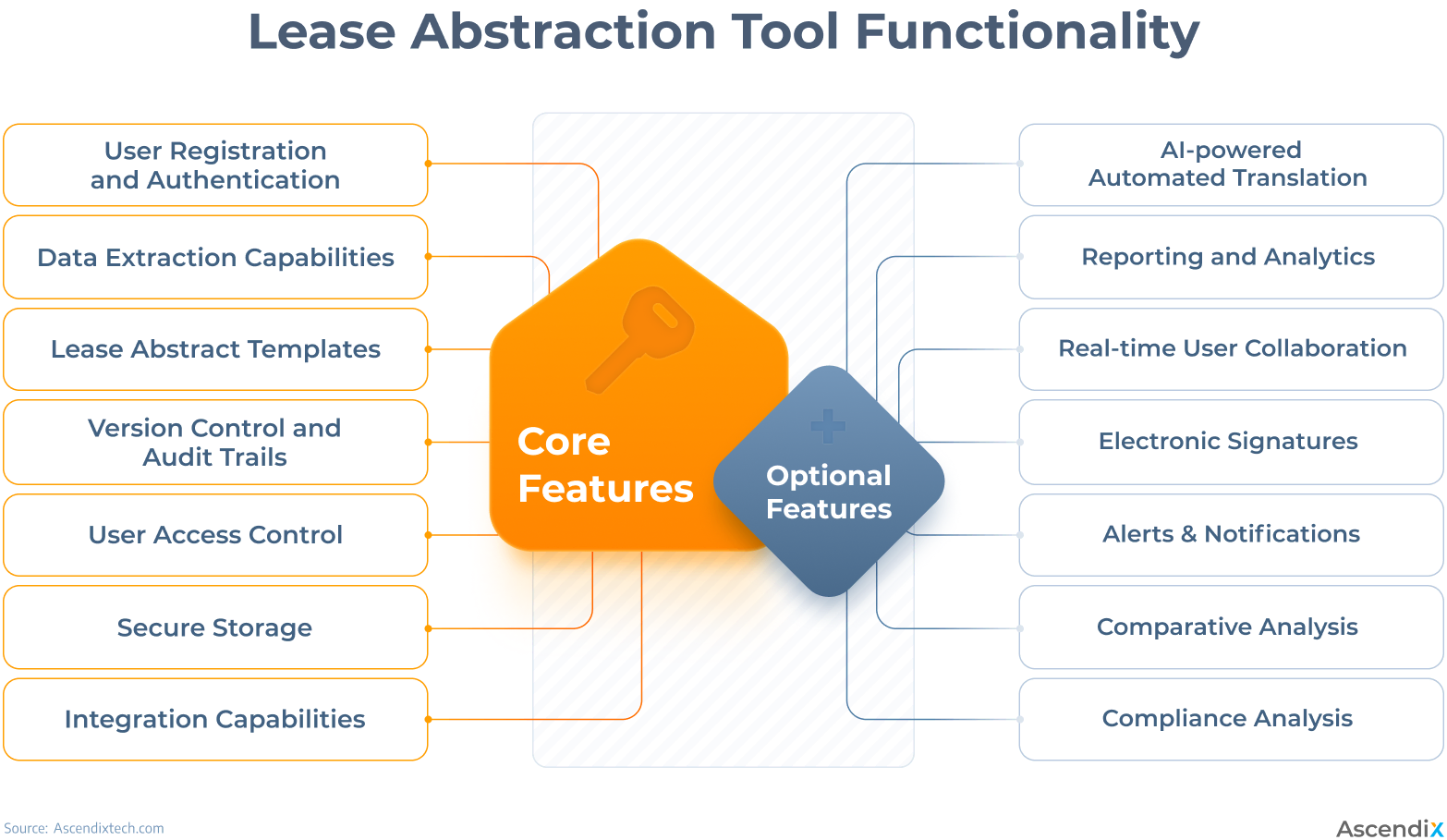
Lease Abstraction Tool Functionality
User registration and authentication – Your software must include secure user authentication methods, such as multi-factor authentication, and ensure team members can easily onboard and set appropriate access levels;
Data extraction capabilities – obviously, the core functionality of your AI lease abstraction software, that’s why it should be powered by Optical Character Recognition (OCR) technology, so your users can automatically extract key information from lease documents;
Lease abstract templates – will they be customizable, or will there be a separate library of pre-defined templates? If you’re building a tool for companies that deal with different types of documents daily, we advise you to ensure that users can customize the data fields they want to extract. And don’t forget that the final lease abstract should be standardized and easy to navigate and search.
For example, we have implemented several customizable templates for summary results. According to their preferences, users can choose among a few options:
A short summary of the article in a one-paragraph format (commonly, such a summary is up to 1000 characters);
A table-format summary with Terms (“Base price,” “Commencement date,” etc.) and Values (“$350 000,” “14th day of November, 2024);
A combined summary where both text and a table are presented to offer a comprehensive view of the document;
And if users dislike all the options above, they can easily create a new template from scratch that will fully align with their specific requirements.
Version Control and Audit Trails – allow users to keep track of document versions and changes made over time, ensuring users are working with the most recent information. As you’ve seen from the screens above, we’ve built our tool with user-friendly design in mind, ChatGPT-like interface, where users can easily navigate between the document and summary sections;
User access control – most tools for automated lease abstraction offer role-based access control. For example, you might want to give some users read-only rights or assign reviewers/editors with the right to review lease abstracts generated by the AI tool and make manual adjustments or corrections;
Secure storage – users should be able to store their documents in the cloud and easily retrieve them from there, which, as you’ve already guessed, is impossible with ChatGPT, but can be done with lease abstraction AI tool;
Integration Capabilities – if you are working as part of a team with one pool of documentation or simply need to get automated summaries of documents already stored in your CRM / deal management system, you will appreciate the integration of your AI lease with your software ecosystem. If you do not need such integration now, make sure that you plan for API capabilities in your custom lease abstraction tool to ensure it can be linked with other systems in the future.
We can make your legacy & 3rd-party systems talk through well-thought-out APIs and integrations. Contact Ascendix today.
Once you’ve finished building the core lease automation functionality, it’s time to choose the optional functionality that will set your software apart from competitors in the market.
AI-powered automated translation – companies with global real estate operations might be looking for this capability so the leases they deal with can be accurately translated and understood across different languages;
Reporting and analytics – Tools may provide reporting features, offering insights into extracted data, lease trends, and other relevant analytics;
Real-time user collaboration – enable multiple team members to work on lease abstraction projects simultaneously;
Electronic signatures – users can sign documents online without a need to physically visit the agent’s office;
Alerts & notifications – once the software detects clauses, terms, and terminology that contradict legal norms, it will send an alert to the user. Also, some automated lease abstraction tools can remind users about ‘sign’ dates, hence prevent missed deadlines;
Comparative analysis – users can conduct comparison checks not only between two specific leases of their choice but also select a lease for comparison against all others in the system;
Compliance analysis – powered by natural language processing technology, this feature can ensure seamless compliance monitoring by automatically scanning lease documents for relevant clauses and regulatory requirements. And if the clause doesn’t comply with industry standards or legal regulations, the system will promptly flag it.
Once you’ve found a proptech development team, you can fully delegate the tool building task to them, but if you’re still interested in the front-end and backend development process in a nutshell and want to know how your AI lease abstraction tool will work from the system perspective, then keep reading.
In our lease abstraction AI development journey, we embraced the Minimum Viable Product approach at the initial stage. This meant creating a functional version of our product with just enough features to satisfy early users and gather crucial feedback for future enhancements. Listening to our users was fundamental, as their insights guided us in shaping the app according to their unique needs and preferences. That’s exactly what we’ll do for you too once you decide to build a proptech software with us.
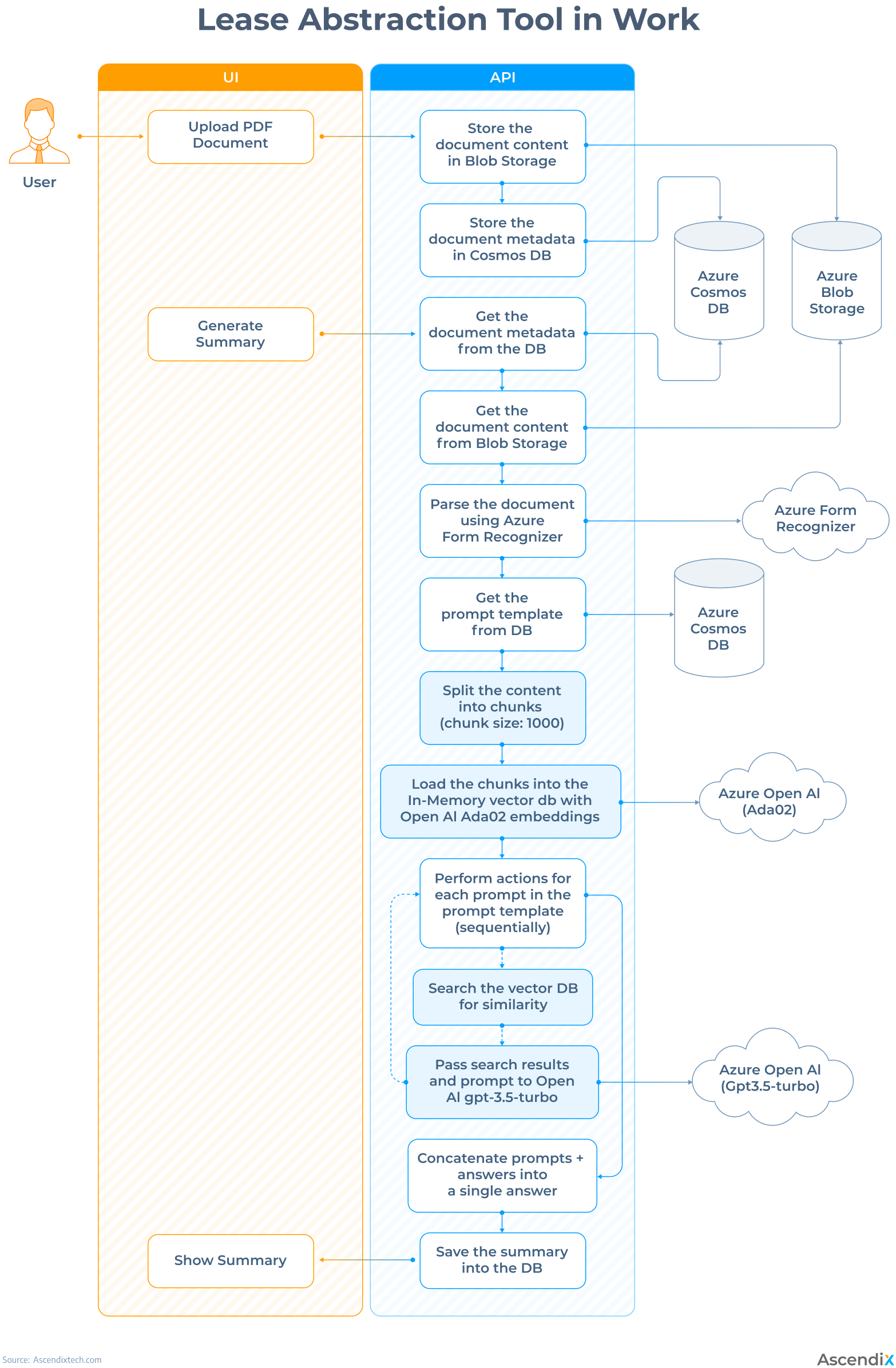
Lease Abstraction Tool in Work
First, our users must register (we’ve ensured the process is simple, safe, and requires basic user data), go through the authentication process and download their document from the local storage. Most of the current lease abstraction tools encourage users to upload their documents in PDF, and our tool does the same, but the functionality of your lease automation app might differ, allowing users to download files in other formats like doc.
With our tool, users can select pre-defined templates or create their own (FYI, some lease abstracting tools do the latter, while others don’t. Just think – What if the lease includes specific items that most leases don’t but which should be displayed in the summary?) and edit or manage the prompt template.
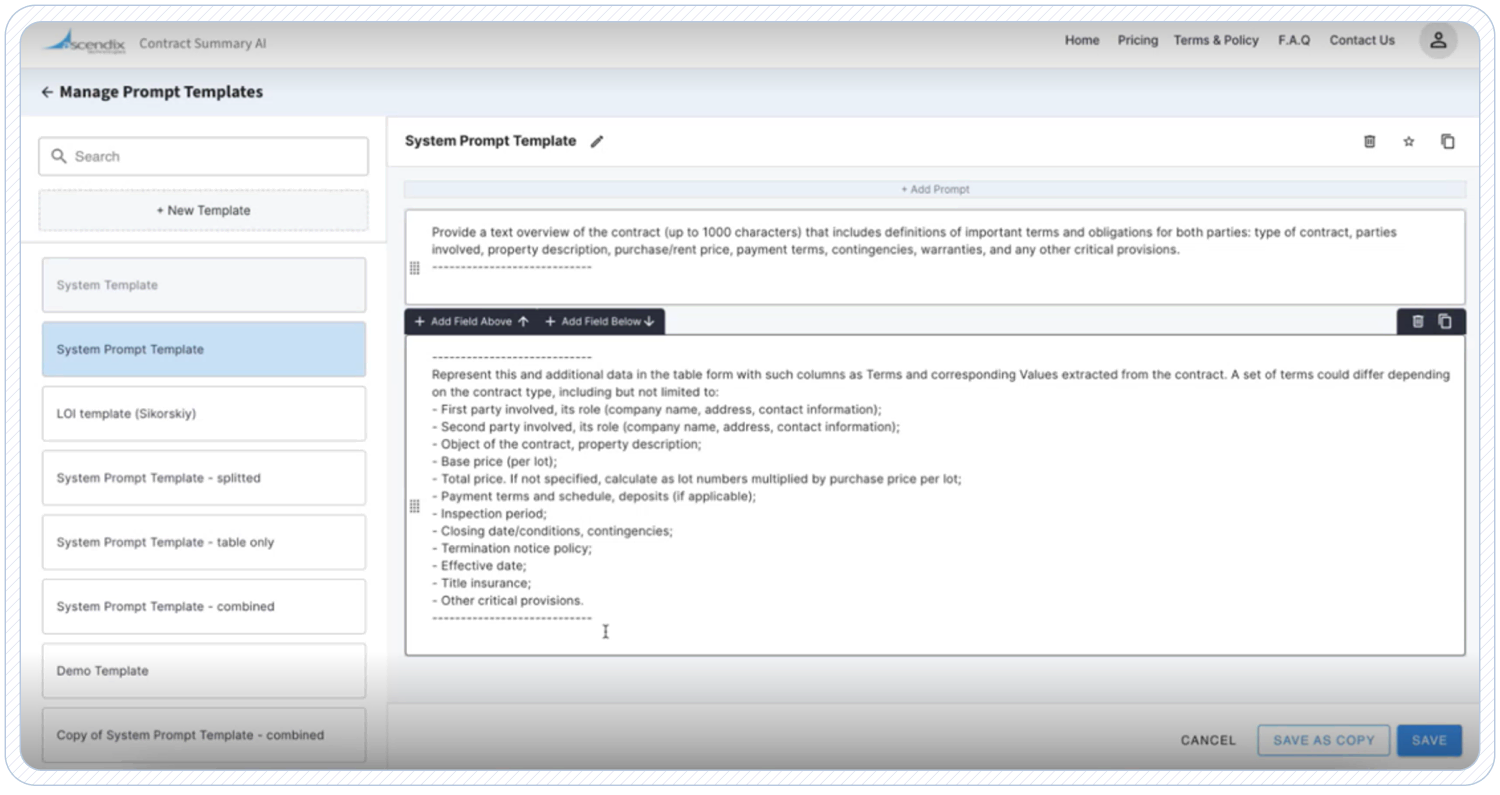
System Prompt Template
Further, users add the template to the system and apply it from there.
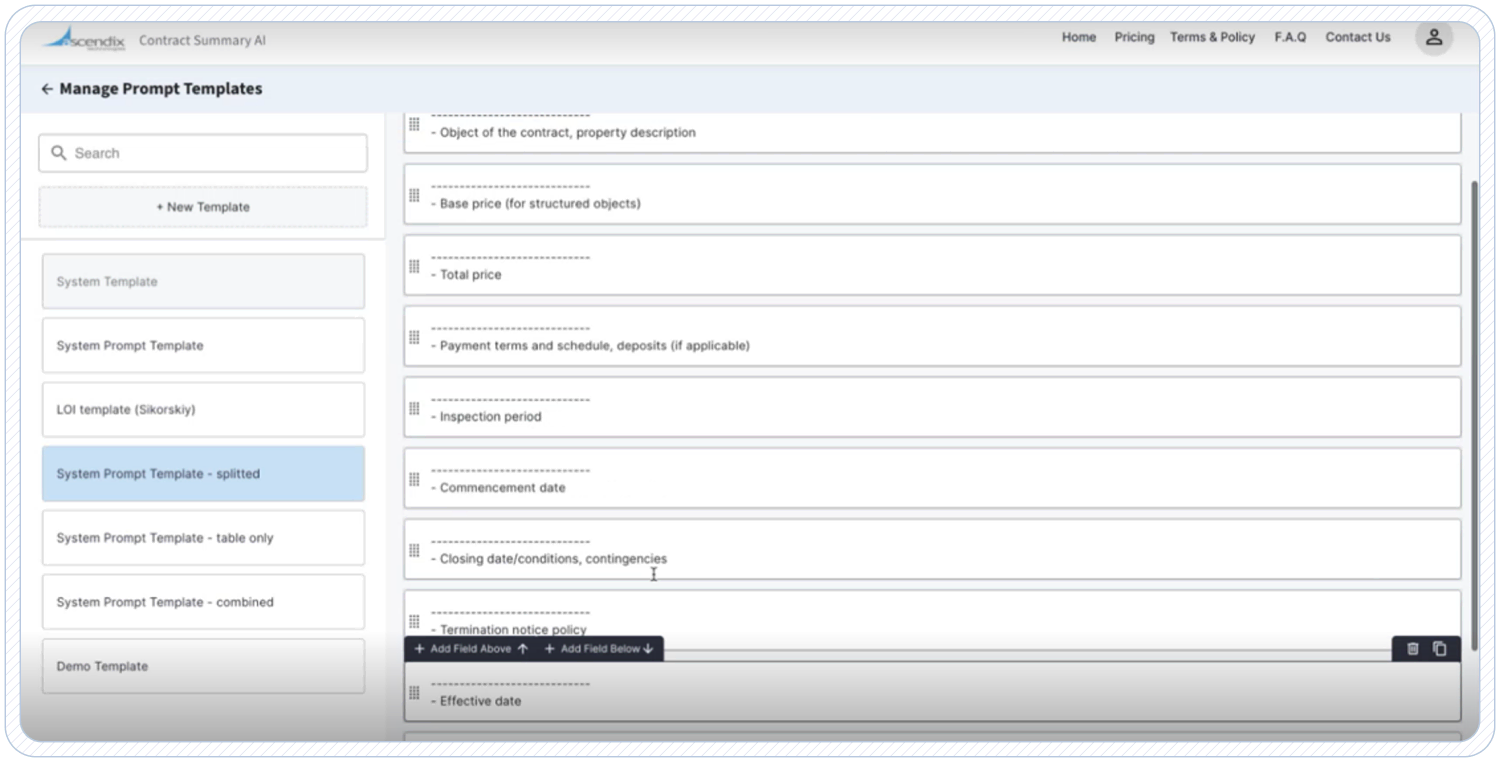
Manage Templates Interface
Oh, we almost forgot to mention that the app’s usability goes hand in hand with a sleek design.
During the development of our tool, we drew inspiration from the intuitive interface of ChatGPT. We envisioned a seamless experience for our users, allowing them to effortlessly switch between the Summary section, the lease reference, and their list of leases.
As you can see, the interface of our lease abstraction tool features a well-organized layout: the list of documents is neatly displayed in a separate column on the left, the summary of the document takes the center stage, and the open original lease is readily available for reference.
Once users upload their commercial lease in a PDF format, the lease content and metadata (without being split into chunks yet) are stored into two vector databases, Azure Blob Storage and Azure Cosmos DB respectively. Here, databases are vital elements, since they not only allow us to store user content and metadata separately, but generally ensure the document integrity and accessibility by acting as reliable and secure storage solutions.
Once the user presses the ‘Generate Summary’ button, the system retrieves both the content and metadata from the vector databases and turns the document into a machine-readable text with the help of Azure Form Recognizer.
Further, the prompt template is applied and with the LangChain library, the system splits the text received from Azure Form Recognizer into chunks and loads them into In-Memory vector database with the help of Azure OpenAI tool.
Yes, we’ve told you that using ChatGPT as a separate lease abstraction AI tool is inefficient, but what we haven’t told you is that ChatGPT is an essential integration to consider when building a lease abstraction AI tool. Let’s find out why.
Once users press the ‘Generate summary’ button, each chunk is processed separately and sequentially. The system looks for each template in the In-Memory database, conducts a similarity search for the prompt in order to reduce the amount of text to be analyzed and transfers the text and the prompt to ChatGPT 3.5 (this is the current version, but once the new version is launched, we can plug in the latter too if it can be supported by LangChain library).
Once ChatGPT answers the prompt questions, the system concatenates prompt answers into a single structured answer, and the format of the answer, which is basically the lease summary, will depend on the user’s choice. So, for this purpose, our tool provides users with format options like a short summary of the article in a one-paragraph format up to 1000 characters, a table-format summary, and a combination of the two.
The best part? We’ve ensured our users can build a perfect lease abstract with a little help from comparative analysis. Users can provide the system with what they consider to be the ‘ideal’ lease abstract, asking the system to evaluate the lease abstract by comparing it to the example.
In the end, the tool will score the abstract and identify any inconsistencies or missed data as a part of the feedback.
After processing the text chunks, our tool stores the lease abstract in the database, then returns and displays it to the user.
As developers, we prioritize the validity of user data. Therefore, users must manually validate the recognized handwritten blocks, accept them, and only after this process can they download their summary.
Currently, our users can download their lease abstracts in PDF only, but don’t forget that we can help you build an AI lease abstraction tool that allows your users to convert their commercial lease abstract into other formats like Excel spreadsheets.
Once we’ve built your lease abstraction tool, our professionals will rigorously assess every aspect of the software, verifying its ability to accurately extract and organize lease data in real-life scenarios.
Further, we’ll deploy your lease abstraction software on a server or company’s devices.
Post-deployment, our commitment to your satisfaction continues. We’ll provide dedicated support services to promptly address any inquiries or concerns that may arise during software usage. Our team will assist your staff during the onboarding process, ensuring they get the knowledge required to navigate the lease abstraction software effortlessly.
We speak real estate. We’ve been developing software products for real estate for 2 decades. Speak to Ascendix consultant.
Features:
Trusted by:
Best for:
Large enterprises and big businesses in need of a complete document management platform
Docsumo, a leading AI lease abstraction company, offers an all-in-one software that allows extraction from various document types, layouts, and tables, featuring pre-trained APIs and an intelligent OCR system. With a 99%+ accuracy rate, the tool extracts data from leases, eliminating manual errors and enabling fast decision-making for property managers, brokers, and law firms.
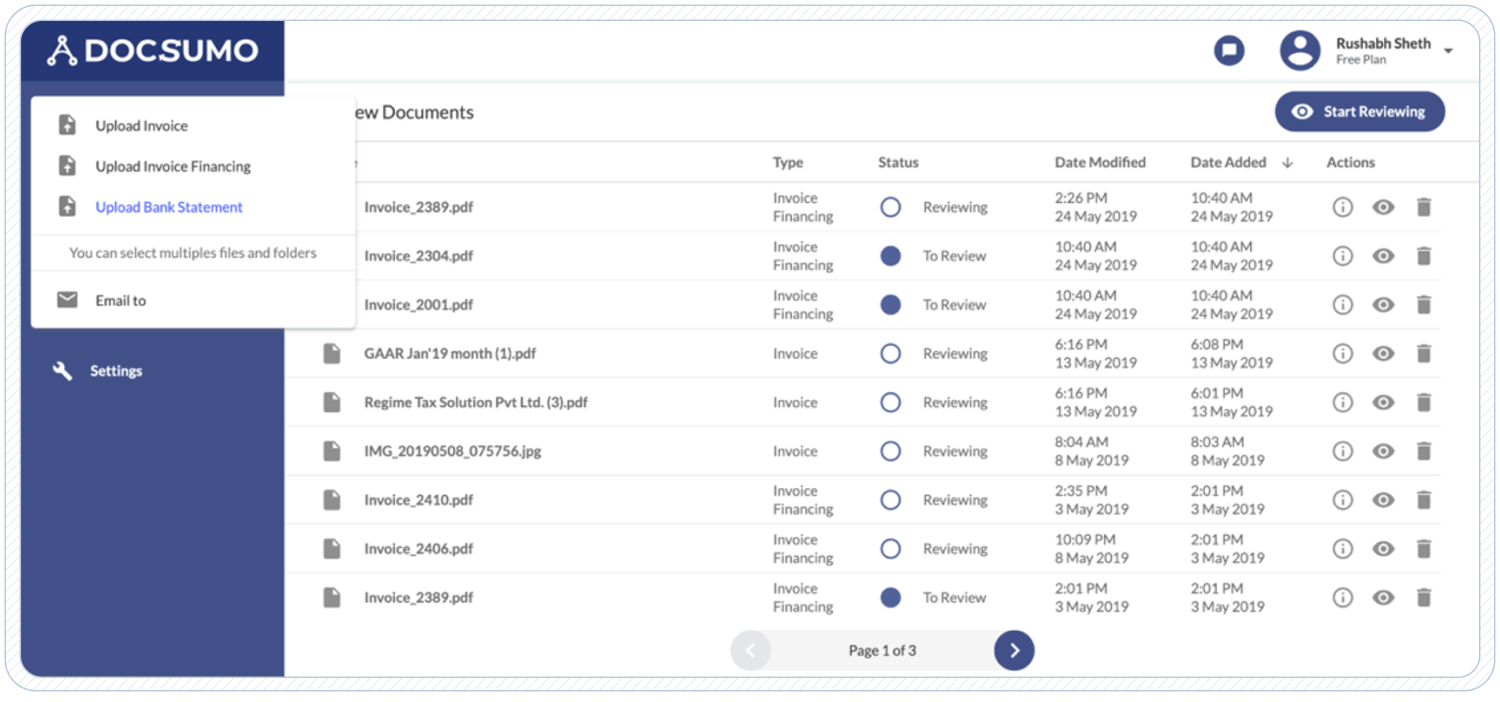
Docsumo’s Interface
Features:
Trusted by:
Best for:
Small businesses with occasional lease abstraction needs
LeaseLens is a dedicated AI lease abstraction tool that extracts and summarizes your data, and can customize these abstracts to your preferences, including critical dates, renewal options, and more. The lease abstraction AI tool is free to use for viewing abstracts, but has a minimal $25 fee for exporting to Excel or Word templates.
Features:
Trusted by:
Best for:
Law firms and businesses operating in the legal industry
Kira, the lease abstraction software by Litera, scans and abstracts all kinds of files or texts. The tool can adapt to Latin-script languages like French, Spanish, and German. Users can export their data to Word, Excel, or other systems. This AI lease abstraction tool also has robust search functionality and allows users to simplify comparisons with bulk redlining against a form, using the “heat map” feature for faster analysis.
Features:
Trusted by:
Best for:
Large to medium businesses handling highly sensitive data
Imprima provides automated lease abstraction as part of the entire lease management process. The tool offers 35 preset fields like “lease space,” “signing date,” and “price.” The values selected from this list are displayed beside the open document, allowing users to locate, edit, and add values. A drawback is that users find Imprima not very user-friendly, and the interface is not quite intuitive.
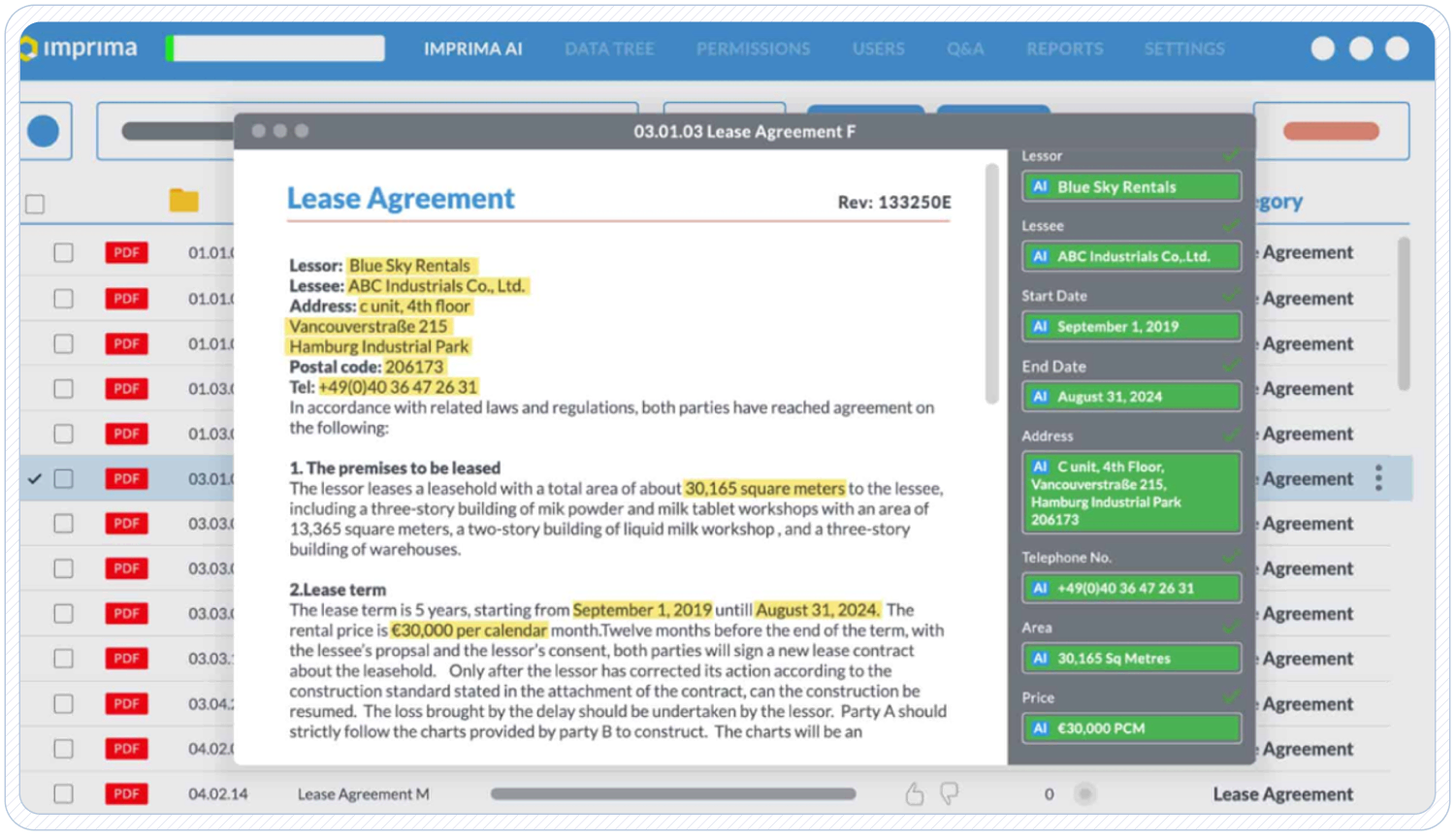
Imprima’s Interface
Features:
Trusted by:
Best for:
Small to large businesses; finance, sales, legal, and HR departments.
Summize speeds up the lease abstraction process by 85%. With its ‘Legal Frontdoor,’ users can engage with chatbots, generate leases with pre-approved templates, and submit requests directly to the legal team if assistance is required. Summize enables task creation, commercial lease abstract generation, and easy sharing for the team, and has a user-friendly interface.
At Ascendix, we assist established real estate businesses that aspire to empower their teams, including brokers, property managers, and legal specialists with AI capabilities in their daily operations.
Why Ascendix?
How can Ascendix help?
For real estate businesses who want to empower their teams (brokers, property managers, legal specialists) – we can build a new lease abstraction software from scratch, audit the existing one and upgrade it for optimal efficiency and scalability.
For startups with visionary ideas of building a lease abstract tool – a Minimum Viable Product (MVP) to attract investors. But it’s not only MVP we offer – we can build a brand new tool from scratch, empower it with APIs, and integrate it with legacy systems;
For investors looking for innovative startups – tech audit and consulting services to ensure your investment aligns with cutting-edge technology trends and promising ventures;
Contact us directly or book a free proptech call to learn how you can leverage our proptech development expertise.
The lease abstraction process involves extracting and summarizing key information from a lease agreement. This information typically includes financial terms, critical dates, clauses, obligations, and other essential details. The lease abstract is then provided in a concise and well-structured manner, often a summary or a table.
AI lease abstraction is the process of extracting key information like parties’ responsibilities, lease terms, and financial obligations with AI lease abstraction tools from a commercial lease agreement and summarizing it into a concise document.
Lease abstraction tools currently on the market are Docsumo, LeaseLens, Kira Systems, Imprima, and Summize.
We are a team of software developers, data analysts, Proptech consultants, and AI experts from the United States and Europe. Since 1996, we've been helping companies make the most out of their software and automate business workflows leveraging advanced technology.

 (38 votes, average: 4.63 out of 5)
 Loading...
Get our fresh posts and news about Ascendix Tech right to your inbox.