Struggling to Navigate Real Estate App MVP Development?
Entrust it to the Ascendix team with extensive real estate and AI expertise. Our MVP development services cover all stages and mitigate the risks so you can focus on improving your idea.


Real estate app development starts with planning, design, and analysis. It takes time, and even after all that effort, the next step is an MVP—a Minimum Viable Product. It’s hard not to invest in a fully-fledged product when you are sure of your idea. But, let’s see why creating a minimum first is one of the most important steps in the Real Estate App Development Guide.
More than 123,000 startups fail to secure funding. Real estate application MVP allows you to validate your ideas and hypotheses about market opportunities, demand, competitors, features you include in the first version, etc. You can gather user feedback and understand what to fix. This way, you will not become a part of gloomy statistics about failed startups.
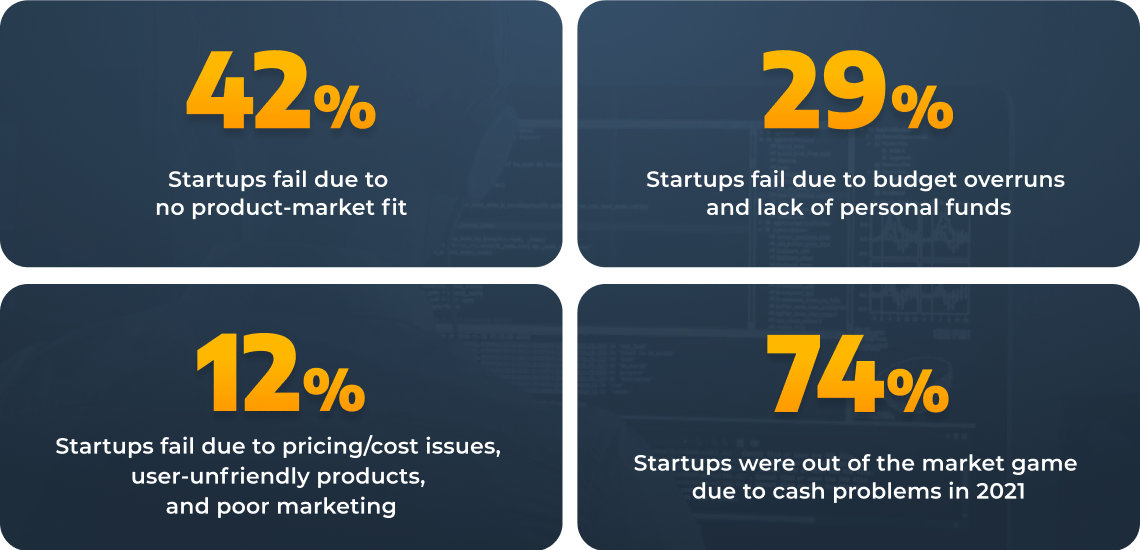
Also, after launching an MVP and gathering the data, you can present results to investors, so they see your real estate application as proven to be in-demand, with fewer risks, and the one with acquired early adopters.
Typically, you can get a real estate application MVP within 6 months. The process generally follows an agile framework, divided into iterative phases to ensure flexibility.

During the first month, teams focus on discovery and planning. Months 2–4 involve UX/UI design, wireframing key user flows (e.g., property discovery, booking viewings), and backend setup (database architecture, APIs, and user authentication). By months 4–6, development includes frontend integration, third-party service connections (e.g., payment gateways, map APIs like Google Maps), and rigorous testing for usability, performance, and security. During the 6th month, the MVP undergoes beta testing to validate functionality.
While 6 months is a common timeline, complexities like AI-driven recommendations, compliance with real estate regulations (e.g., data privacy laws), or advanced AR/VR property tours may extend the schedule.
There are real estate applications for everyone and everything and if your solution is nothing new, you will inevitably get lost among others. You can validate your idea in three steps:

Zillow Business Model | Source: Corpoinsights
Use the MoSCoW method to understand which features should be included in your real estate app MVP. MoSCoW method breakdown:
With the MoSCoW method, you will understand the structure of your real estate application better, see the directions for future scaling, and prioritize the right functionality that will show the essence of your app and will not drain the budget.
After successful launches of over 17 own real estate products, the Ascendix team has gathered a few essential features that fit the majority of real estate applications. Among the basic ones are user profiles, calendar integration, map search, filters, cost calculator, and property profiles.
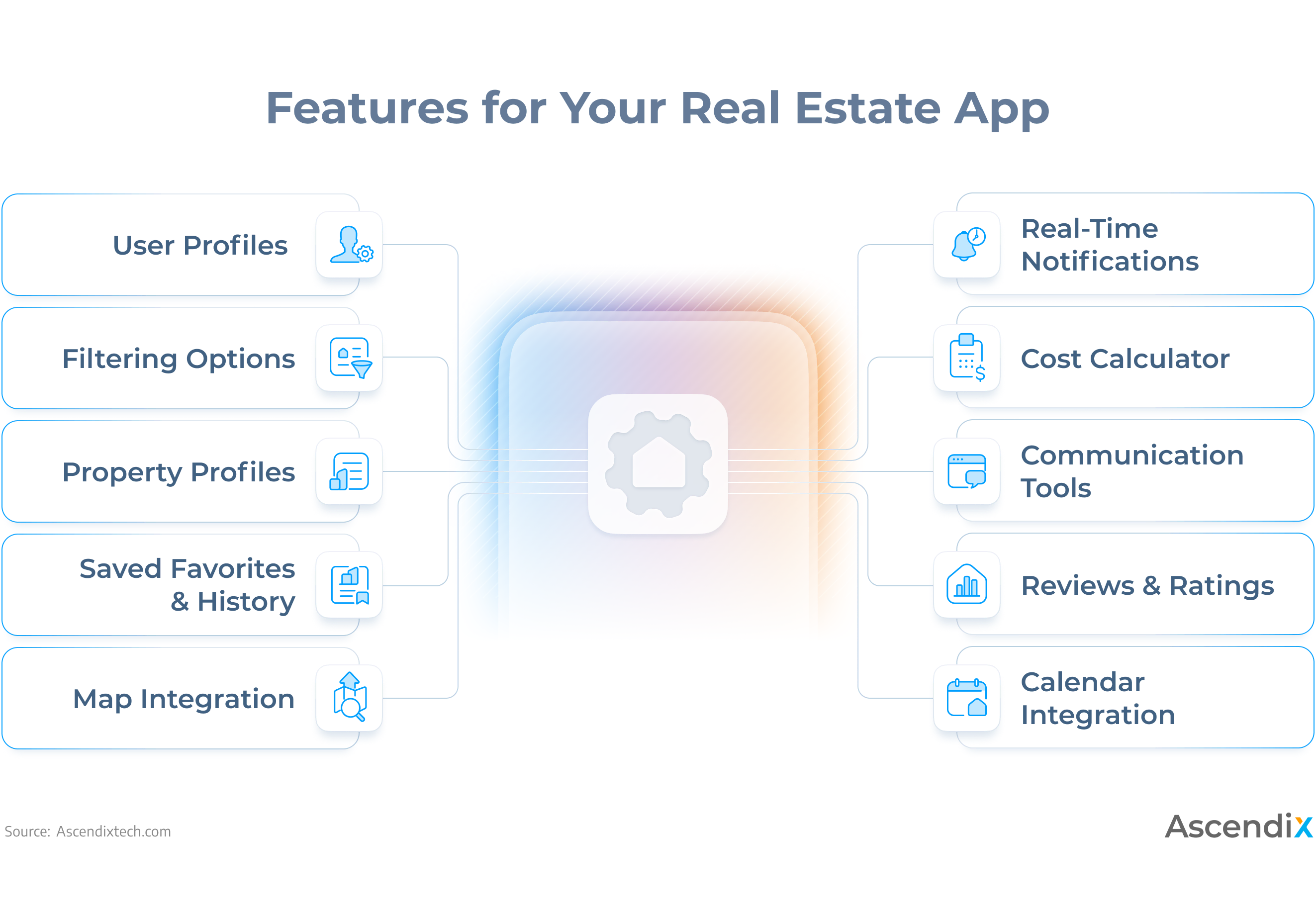
Real estate mobile app features | Source: Ascendix
Entrust it to the Ascendix team with extensive real estate and AI expertise. Our MVP development services cover all stages and mitigate the risks so you can focus on improving your idea.
A good user interface is not only about appealing pictures but about catching user’s attention and reflecting your brand.
Focus on simplicity, clarity, and user-centric workflows to stand out. For a better understanding of user experience, start by wireframing core user journeys like property searches, agent contact flows, or virtual tour bookings.
Pay attention to the mobile interface. Most applications, including real estate-specific, are used via smartphones. Invest in good mobile compatibility with plans for future real estate mobile application development.

Ticketing System Interface | Source: Ascendix
Ascendix has a team of experienced and creative designers who can bring your vision to life and suggest more user-friendly ways of implementing your ideas. Learn more about our UI&UX design services.
Even if you are a knowledgeable senior developer, you will struggle with developing the real estate application solo. Hiring a full-time developer and designer is time-consuming and implies long-term commitment. Freelancers are often unreliable. So, you should consider hiring a professional vendor with a proven track record in the real estate industry with flexible payment options or one ready to work with a fixed budget.
Proptech companies already know where to start and how to navigate you through the challenges of real estate app development. For example, Ascendix is an old hand in real estate application and software development with top clients like JLL and Hanna Commercial. We have a few team engagement models to fit your needs and budget.
Consider a fractional team engagement model for cost efficiency and expertise.
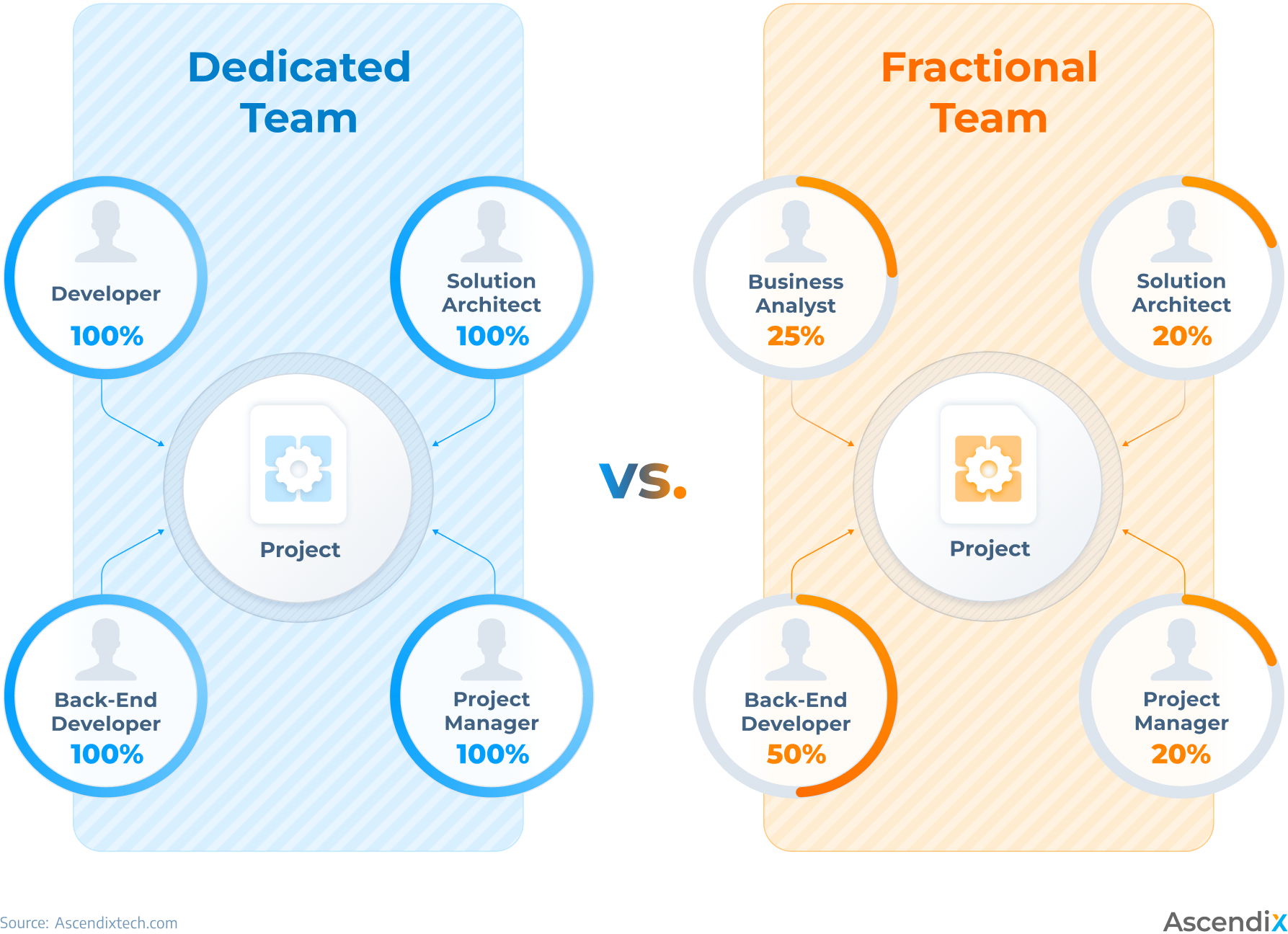
Fractional Team Engagement Model for Real Estate Software Development | AscendixTech
Building real estate application MVP is the most costly and time-consuming process with many stages, iterations, professionals involved, and pitfalls. Hire a professional vendor to avoid flopping even before launching.
Low-fidelity MVPs are used to check if there is a demand for your solution. Launch a “fake door” MVP also called an “audience building MVP” or “an MVP before the MVP.”
“The Fake Door” MVP can be implemented through a landing page, email, or marketing campaign. A landing page is relatively more affordable and feasible for digital products. An email campaign is a good option if you have an email base of potential customers. Marketing campaigns are the most expensive approach since they include paid ads and promotions.
Potential users will show their interest through clicks and will be redirected to the “coming soon” or “under construction” message. They can leave their contact info to get the product first and this way you’ll get your early adopters base. Through heat maps, you can see what features gathered the most attention.
Pre-launch isn’t about perfection—it’s about proving your idea has a market.
If you are a startup, effective pitching is the key to success. But investors fund traction, not ideas. Use pre-launch insights to craft a pitch that highlights validated demand through metrics like waitlist sign-ups, click-through rates on key features, or survey results.
Show the market gaps and how your solution fits there. For example, “90% of tenants with pets claim that property search time has increased by 70% when they got their first pet. Marketplaces like Zillow have limited pet-friendly options. Our real estate applications will be focused on pet owners.”
Outline your monetization strategy—freemium models, subscription tiers for premium features, or agent referral fees—to show scalability.
Finally, address risks head-on. Acknowledge competitors but emphasize your differentiator. For example, “Zillow provides filters for sorting pet-friendly listings, but our real estate application has a database of not only properties for rent but also cafes and parks. Also, we see a potential for developing an inner community for sharing pet-friendly spots as over 90% of tenants with pets expressed their interest in joining this initiative.”
Investors want proof you’ve done the homework—not just a flashy idea. Ascendix’s business analysts and designers can help you curate an ideal pitch deck to attract more funding.
At Ascendix, with over 300 real estate products built and scaled over two decades, we’ve seen firsthand how even well-intentioned MVPs can falter when teams underestimate industry complexities. As product authors ourselves, we’ve weathered the pitfalls and turned them into lessons that cost others millions but now fuel our playbook for smarter, leaner development.
The common mistake in real estate app development is focusing solely on features, monetization, and ideas forgetting that the real estate industry has strict regulations and laws.
What to pay attention to:
Garbage data = garbage app. Outdated listings, incorrect prices, or fake property photos erode trust. Modern users can easily switch between applications. If your real estate app involves the tiniest bit of frustration, you lose users.
Solution: access to specialized databases, ban user profiles that spread misinformation or post fake listings, do not offer automated property valuation if you cannot guarantee accuracy, and consider hiring a vendor with AI expertise to train your AI solutions on high-quality data.
Real estate apps handle sensitive data like financial info, contracts, and IDs. One data breach can sink your reputation, funding chances, and user trust. That’s why, in addition to obligatory data protection regulations, real estate apps should be resilient to cyber-attacks and fraudulent activities.
Solution: advanced encryption and third-party security audits. For example, Ascendix adheres to enterprise-level security standards, and certifications, and uses AES-256 (Advanced Encryption Standard with a 256-bit key).
Our data engineering team ensures models are trained on high-quality, robust datasets and implements best practices for data governance and security.
It’s hard to believe that your real estate app MVP can have over 100 users at the same time. But often good promotion and innovative ideas make an application gain rapid popularity and then scalability issues begin. And your MVP now works for 100 users but crashes at 10,000.
Solution: use scalable cloud infrastructure and conduct stress testing before launching.
Those are some of the most common pitfalls. As your project evolves, new challenges appear. Hire a trustworthy tech partner to mitigate them effectively.
Ascendix team has developed 17 of our own real estate-focused products and helped over 300 clients worldwide do the same. We have over two decades of experience in the real estate industry and robust AI expertise.
What you get:
Tell us about your idea and let’s create successful real estate applications together.
Kateryna is passionate about exploring proptech technology trends and innovative solutions for real estate. In her articles, she dives into the world of proptech to share industry news and insights to help modernize real estate workflows.

 (13 votes, average: 4.46 out of 5)
 Loading...
Get our fresh posts and news about Ascendix Tech right to your inbox.